
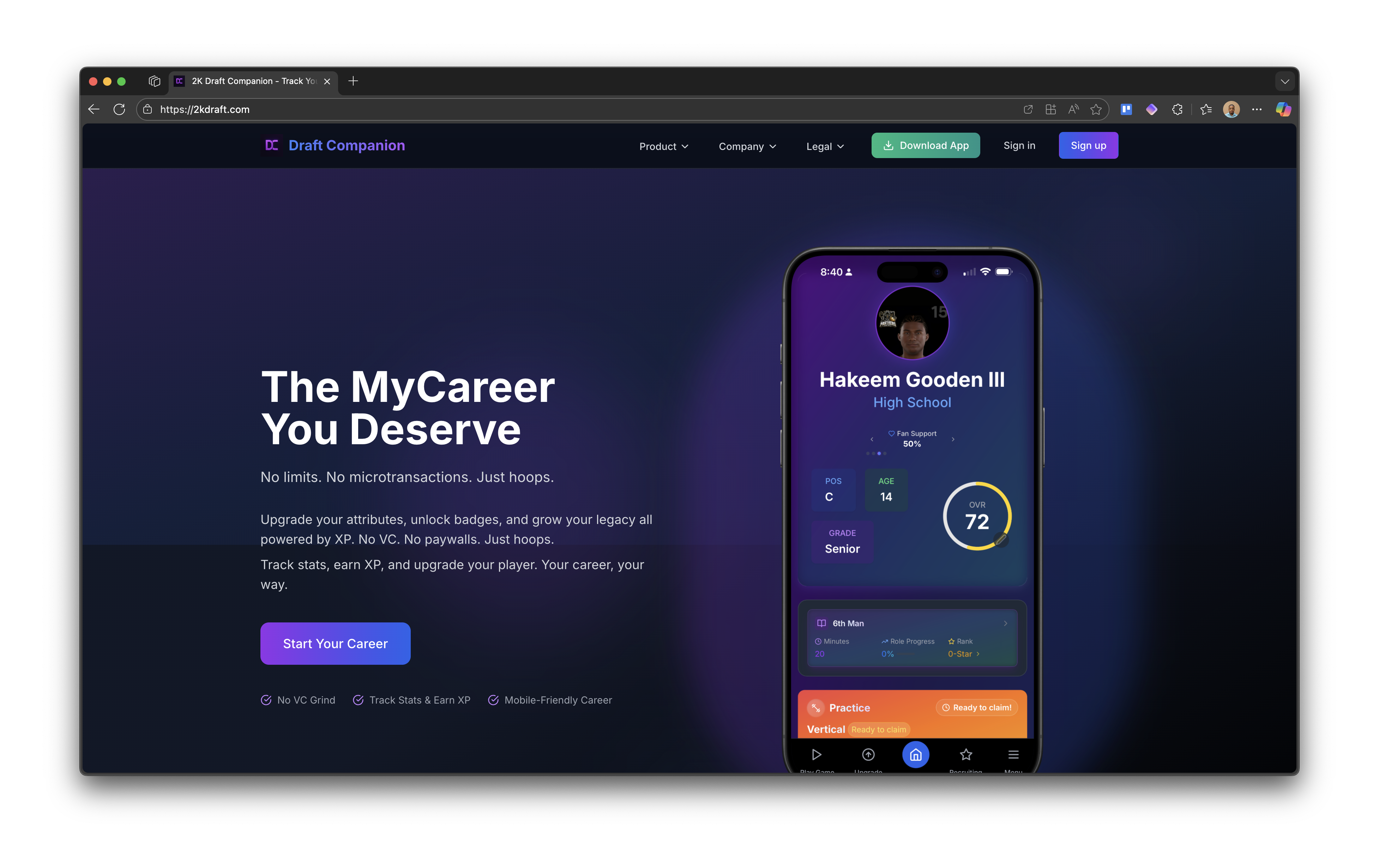
Most successful products start with a personal problem. Draft Companion began during a vacation when I wanted to play NBA 2K's MyCareer mode but couldn't justify spending real money on Virtual Currency just for a short gaming session.
One week later, I had built a working prototype. One year later, over 10,000 players worldwide were using it to take control of their MyCareer experience without microtransactions. Here's the complete story of how we built, launched, and grew Draft Companion.
The Problem: Gaming's Microtransaction Trap
NBA 2K's MyCareer mode is one of the most popular game modes in sports gaming. You create a player, start in high school, work your way through college, get drafted to the NBA, and build a legendary career. It's compelling gameplay with one massive problem: progression is locked behind Virtual Currency (VC).
The Frustration
Players face an impossible choice:
- Grind for 100+ hours - Play repetitive games to slowly earn enough VC to upgrade your player
- Pay real money - Spend $50-100+ on VC to skip the grind and actually enjoy the game
- Play with a terrible player - Start with a 60-overall rating and get destroyed by AI opponents
This isn't game design—it's predatory monetization. Players who already paid $70 for the game are forced to pay more just to have fun. The worst part? Your progress resets every year when the new game releases.
"I just wanted to play a few games during vacation without spending $50 on VC. That frustration became the spark for Draft Companion."
The Solution: Give Players Control
I built the first version of Draft Companion in one week. It was simple: track your stats, earn XP based on performance, and upgrade your player without spending a dime. No microtransactions. No grinding. Just basketball.
Core Features
Draft Companion gives players everything they need to build their dream MyCareer:
- XP-Based Progression - Earn experience through gameplay performance, not grinding or paying
- Full Career Tracking - Progress from high school → college → NBA with realistic milestones
- Attribute & Badge Upgrades - Complete control over player development
- Awards & Achievements - MVP, DPOY, Rookie of the Year, All-Star selections
- Fanbase Building - Grow your following and unlock endorsement opportunities
- Cross-Device Sync - Continue your career on any device, anywhere
The Tech Stack
We built Draft Companion with modern, scalable technologies:
- React - Fast, responsive frontend with excellent user experience
- Supabase - Real-time database with authentication and cross-device sync
- Render - Reliable hosting with automatic deployments
- AI Integration - Smart features without breaking the budget on API costs
Launch Strategy: Community-First Growth
We didn't have a marketing budget. We didn't run ads. We didn't hire influencers. Instead, we focused on solving a real problem and letting the community spread the word.
Week 1: Soft Launch
I shared Draft Companion on the NBA 2K subreddit with a simple post: "I built a tool to track MyCareer without VC. Thought you might find it useful."
The response was immediate. Players who had been frustrated with the VC system for years finally had an alternative. Within 24 hours, we had 500 users. Within a week, we had 2,000.
Month 1-3: Rapid Iteration
We listened to every piece of feedback. Users wanted:
- More detailed stat tracking
- Career milestones and achievements
- Better mobile experience
- Offline mode with sync
- Multiple player profiles
We shipped updates weekly. Every feature request was evaluated and prioritized. The community saw we were listening, and they became our biggest advocates.
Month 4-12: Sustainable Growth
As the user base grew, we introduced a freemium model to sustain development:
- Free Tier - Core features available to everyone
- Light ($9.99/year) - Enhanced tracking and additional features
- Full ($19.99/year) - Complete access to all features and AI tools
The key was respecting users. No paywalls on essential features. No aggressive upselling. Just honest value at fair prices.
The Results: Beyond Our Expectations
After one year of continuous development and community engagement, Draft Companion exceeded every goal we set:
Key Metrics:
- 10,000+ active users - Worldwide player base across all platforms
- 1+ year live - Continuously evolving based on user feedback
- 3 pricing tiers - Serving everyone from casual to hardcore players
- Growing Reddit community - Organic engagement and word-of-mouth growth
- Zero paid acquisition - 100% community-driven growth
- 4.8/5 user rating - Consistently positive feedback and testimonials
But the numbers only tell part of the story. The real impact is in the messages we receive from players who finally feel in control of their gaming experience.
What Made It Work: Key Success Factors
1. Solving a Real Problem
Draft Companion wasn't built to chase a trend or capitalize on a market opportunity. It was built to solve a problem I personally experienced. That authenticity resonated with users who felt the same frustration.
2. Starting Simple
The first version took one week to build. It wasn't perfect. It didn't have every feature. But it solved the core problem: letting players upgrade without VC. We launched fast and iterated based on real feedback.
3. Community-Led Development
We didn't build in isolation. Every major feature came from user requests. Every update was shared with the community. Players felt ownership because they were part of the process.
4. Respecting Users
Our freemium model was designed to be fair. Free users get real value. Paid users get premium features without feeling exploited. No dark patterns. No aggressive upselling. Just honest pricing.
5. Technical Excellence
We built Draft Companion with scalability in mind. React for performance. Supabase for real-time sync. Render for reliable hosting. The tech stack allowed us to grow without technical debt.
6. Cost-Effective Infrastructure
We integrated AI features without breaking the bank. We optimized database queries to minimize costs. We built a Light tier that delivered value while keeping infrastructure affordable. Smart technical decisions enabled sustainable growth.
Challenges We Overcame
Complex Career Progression
Building a system that handles high school → college → NBA progression with different rules for each stage was technically challenging. We had to architect a flexible backend that could adapt to various career paths.
Cross-Device Sync
Players wanted to start a career on desktop and continue on mobile. Implementing real-time sync with offline support required careful database design and conflict resolution strategies.
Balancing Free vs. Paid
Finding the right features for each tier took iteration. We wanted free users to have a complete experience while giving paid users meaningful upgrades. The balance had to feel fair to everyone.
Scaling Infrastructure
As we grew from hundreds to thousands of users, we had to optimize database queries, implement caching, and upgrade hosting. Growth is exciting but comes with technical challenges.
Key Takeaways for Entrepreneurs
Building Draft Companion taught us lessons that apply to any product development project:
- Solve your own problem first - The best products come from personal frustration. If you need it, others probably do too.
- Launch fast, iterate faster - Don't wait for perfection. Get a working version out and improve based on real feedback.
- Community beats marketing - Word-of-mouth from happy users is more powerful than any ad campaign.
- Respect your users - Fair pricing and honest communication build trust and loyalty.
- Technical decisions matter - Choose a stack that scales. Technical debt compounds quickly.
- Listen, but filter - Take all feedback seriously, but prioritize what aligns with your vision.
- Sustainability over growth - Build a business model that works long-term, not just for launch.
The Bottom Line
Draft Companion went from a one-week side project to a platform serving 10,000+ users worldwide. We didn't have a big budget, a large team, or a detailed business plan. We had a real problem, a working solution, and a commitment to listening to our users.
The lesson? You don't need everything figured out to start. You need a problem worth solving, the skills to build a solution, and the willingness to iterate based on feedback. The rest comes from execution.
Whether you're building a web app, launching a service, or starting any business, the principles are the same: solve real problems, start simple, listen to your users, and build something that respects them.
That's how you go from zero to 10,000 users. That's how you build something that lasts.